


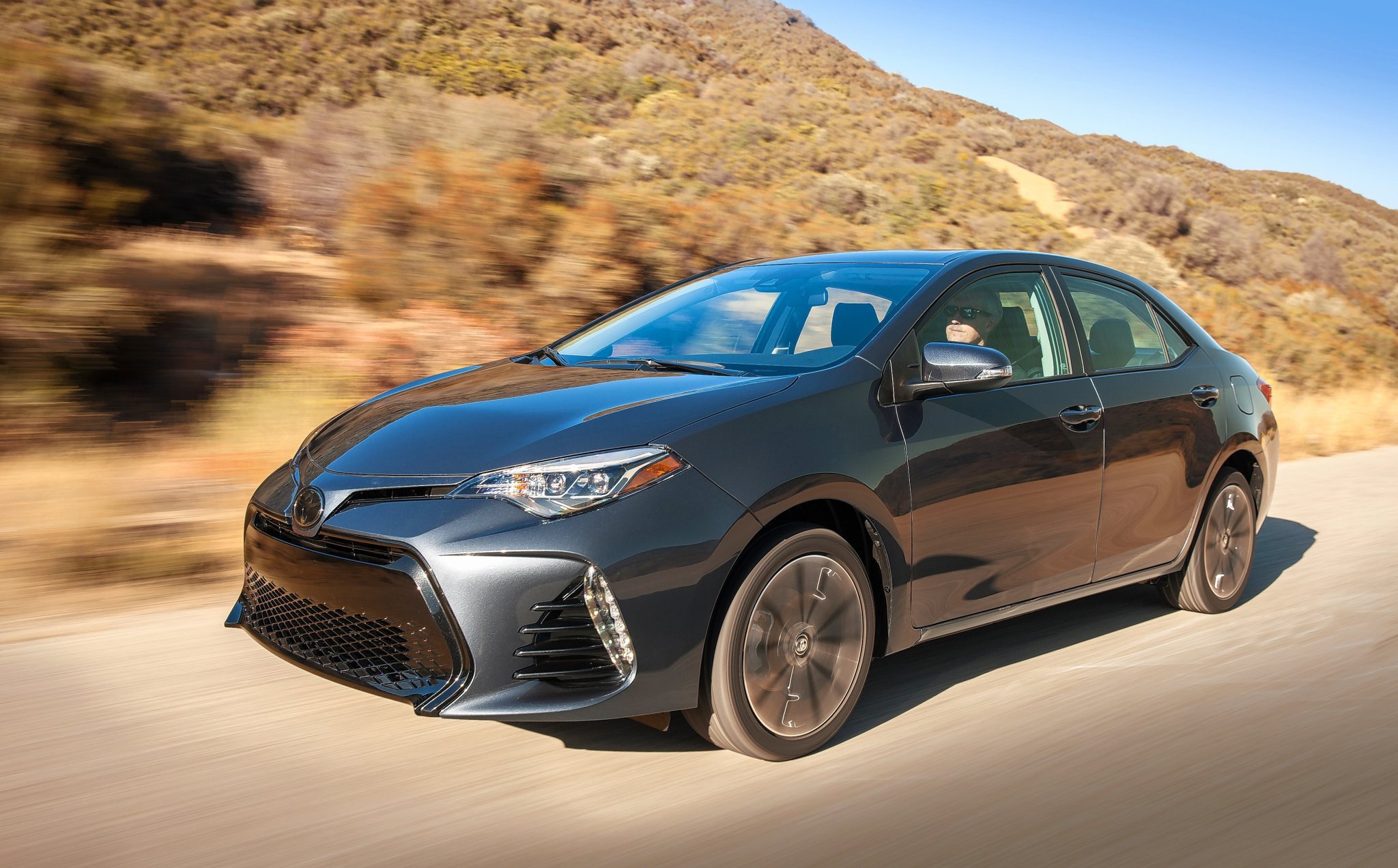


Corolla debuted in its home market of Japan in 1966, prior to its U.S. arrival two years later. From unassuming beginnings, Corolla blossomed into a best-selling car worldwide, topping 43 million sales thus far thanks to above-average gas mileage and a well-earned reputation for dependability.
In the 2014 model year, Toyota introduced the 11th generation redesign while delivering sales numbers that continue to pop. Part of Corolla’s success may relate to its never-wavering naming stance.
Recalling compact cars that have cycled through the marketing mill since the late 1960s takes some thought. While Cobalt, Chevette, Pacer, Neon, Dart (twice), Cavalier, Pinto, (feel free to add a name here) have come and gone, Toyota’s done just dandy with Corolla.
Toyota’s newest U.S. assembly complex in Blue Springs, Mississippi, outside Tupelo, supplies a majority of Corollas sold in the States. Corollas began flowing out of Blue Springs in the fall of 2011.
Two years ago, a five-door hatchback (Corolla Matrix) retired from the lineup. But last year, Toyota announced the discontinuation of its youth-obsessed Scion division, herding many remaining Scions into the Toyota stable. Thus, a five-door Corolla-branded hatchback returns soon: the Corolla iM (the one-time Scion iM.)
In calendar year 2015, front-wheel drive Corolla sales totaled a very robust 363,332, up 6.7 percent from 2014 — qualifying as the second best-selling U.S. car behind Camry’s 429,355 sales.
Corolla’s 2015 silver-medal finish represents steady forward progress from a No. 6 ranking in 2013 and third-place finish in 2014 (behind Camry and Honda’s mid-size Accord).
A wide ranging trim list includes: L, LE, SE, XLE, XSE and high-mileage SE ECO. Historically speaking, LE leads in volume sales. Also on board for a short tour is a 50th anniversary SE edition boasting special paint and upgraded audio.
Seems Corolla could do with a trim or two less to ease transaction interaction, but with breakneck sales, maybe Toyota knows best.
Updates for 2017 include a new front-end design along with additional safety updates. Also, a rearview backup camera now comes standard across all trim levels.
Returning once again to power Corolla: a 1.8-liter, double-overhead cam, inline, 16-valve four-cylinder cranking out 132 horsepower. The SE ECO trim tweaks things slightly with “Valvematic” technology to meet California emission standards while boosting horsepower by 8.
Two transmissions include a six-speed manual (SE editions) and a CVT (continuously variable transmission) favoring fuel economy over high-potency, zero-to-60 times.
The 13.2-gallon tank utilizes regular, 87 octane fuel for both engines. Fuel economy rates slightly above average with the 1.8-liter four-cylinder coupled with CVT delivering 28 miles per gallon city and 35 mpg highway. Specially tweaked ECO trims with diminutive 15-inch tires reach 40 mpg highway.
Our top echelon XSE tester started at $22,680 with a bottom line of $24,416 after factoring in $209 side body molding, $309 illuminated door sills, $129 mud guards, $224 carpeted trunk and a factory-to-dealer destination fee. The lowest-priced 2017 Corolla base L trim starts at $18,500.
The relatively conservative exterior receives upfront upgrades for 2017. Joining the large, bottom-heavy air dam and thin grille are headlight tweaks: bi-LED headlights take up residence inside narrow headlight housing in L and LE trims while full LED, jewel-like designs adorn remaining trims.
Push-button electronic start comes in most trims, but direct access remains a bit encumbered by the steering wheel. A more conducive location may be the current site of the less-used hazard button, currently northeast of the start/stop button and easily accessible.
Rear seats allow for two larger adults to travel in comfort, with commendable second-row leg room for a compact-sized transport.
The intuitive dashboard layout includes a glance-able digital clock in the center, flanked by horizontal air vents. Circular air vents dot dashboard ends. At night, the clock adopts cool blue illuminations.
The conventional instrument panel includes two chrome-rimmed, circular analog gauges flanking a vertical digital message screen. The right-side speedometer orb houses a fuel gauge.
XLE and XSE editions feature a 7-inch, user-friendly, multifunction touch screen under the digital clock flanked by low-tech, yet highly convenient volume and station rotary buttons. Other trims get by with a 6.1-inch screen.
An eye-appealing ventilation system operates via three narrow, long tap buttons (temperature, fan speed, direction) with visual cues illustrated inside a digital window.
As with most Toyota products, cruise control operates from a square steering wheel appendage at 5 o’clock. Corolla took a leap forward with radar-enhanced cruise control that automatically adjusts highway speeds based on the speed of the vehicle ahead.
In fact for 2017, radar cruise control is standard in all trims, bundled within “Toyota Safety Sense,” of TSS. In addition to radar cruise control, TSS adds a pre-collision system with pedestrian detection, lane-departure alert and automatic high beam headlights.
Considering its compact dimensions, Corolla creates a “cone of silence” usually found with luxury brands. Borrowing some insulation techniques acquired from Toyota’s upmarket Lexus division, Corolla’s quiet cabin differentiates itself from competitors.
Corolla, never intended for closed-circuit track time like some luxury compacts or an aptly equipped Mazda3, keeps returning customers content with its dependable pedigree. Within the crowded compact class, Corolla delivers perfectly acceptable handling characteristics for around town and highway challenges.
At an even 13.0 cubic feet, trunk volume remains respectable for the compact segment. Corolla includes a temporary spare tire in all trims, a perk becoming a rarer sight and not always a given.

