


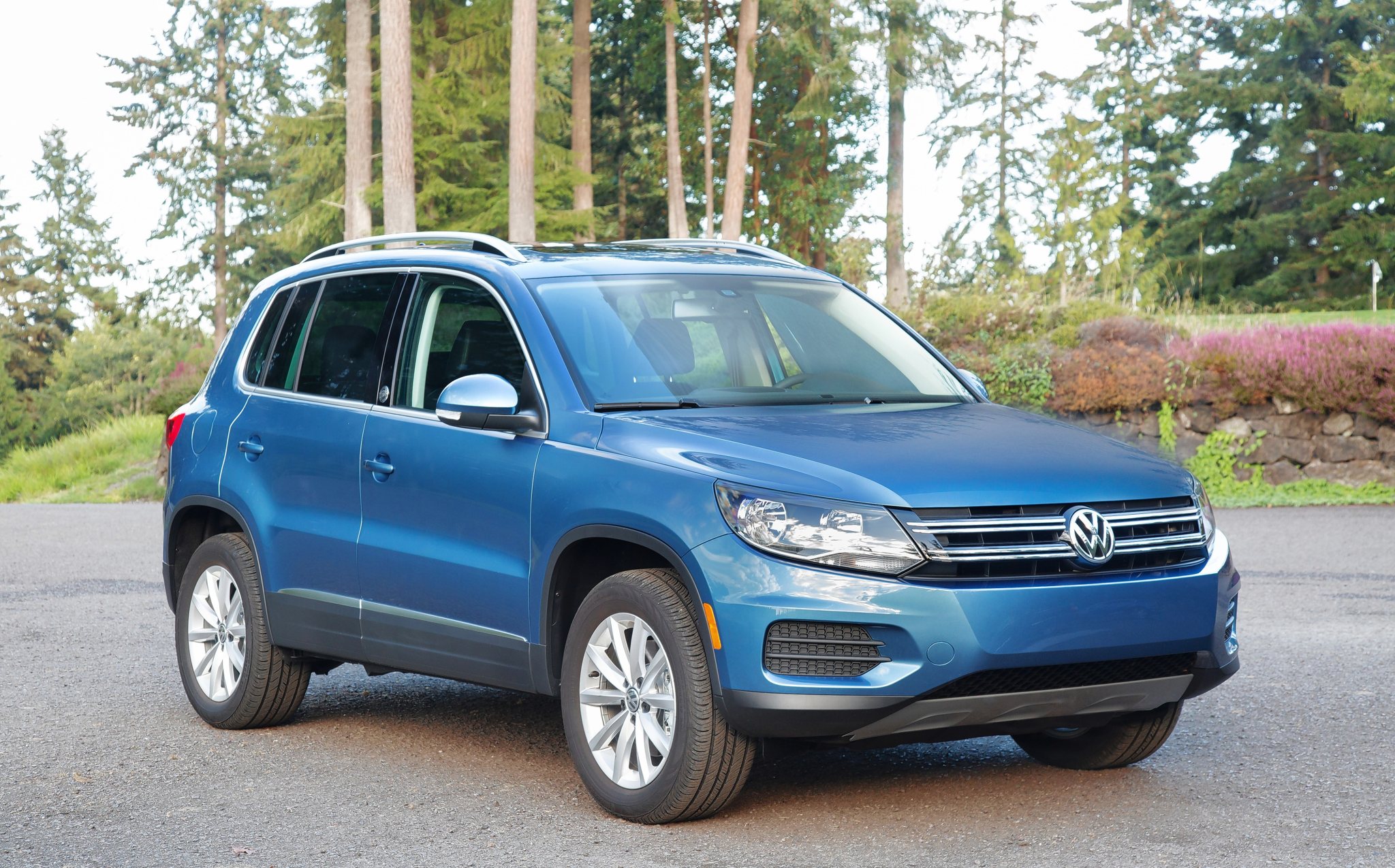


Europe’s largest automaker historically has taken a wait-and-see, glean-from-what-works approach to the U.S. crossover segment.
Volkswagen’s first foray into the burgeoning crop of compact crossover SUVs began back in the 2009 model year with Tiguan’s debut. The segment’s birth, of sorts, took place a dozen or so years prior in the mid 1990s with the launch of Toyota’s RAV4. During the subsequent decade, most major mainstream automakers introduced a player into the entry-friendly segment.
What did VW learn from the growing cadre of “cute utes?”
First, include the choice of front-wheel or all-wheel drive (which VW markets as 4Motion). Four-wheel drive comes in handy, especially for hearty Midwesterners.
Second, keep engines four cylinders, yet potent. Tiguan’s sole powertrain, a 2.0-liter turbocharged four-banger, cranks out 200 horses while teaming with a standard six-speed automatic transmission with performance sports mode.
Third, cast a wide appeal. While Tiguan does not excel in any one category (not the largest or least expensive), it blends the entire driving experience nicely together.
Many lessons learned from Tiguan’s trek will soon be applied to VW’s long-awaited three-row mid-size crossover constructed at the German automaker’s sole U.S. plant in Chattanooga, Tennessee. Scheduled to arrive in the 2018 model year, this yet unnamed vehicle will joust with family-friendly mid-size SUVs, including the Honda Pilot and Mazda CX-9.
For Tiguan, the 2017 chapter undergoes minimal changes from 2016. The trim lineup now consists of base S, new Wolfsburg Edition, new Sport (with sport-tuned suspension and firmer settings) and SEL.
Our nicely loaded test vehicle, a new-to-the-dossier Wolfsburg Edition with 4Motion and standard panoramic sunroof stretching over both rows, checked in at $31,970. With a $865 factory-to-dealer destination charge, the button line ended at $32,835, a few euros higher than similar-contented rivals.
A base front-wheel drive S trim starts at $24,995. Need 4Motion? Add $1,975. It’s available in all trims.
The Wolfsburg, Sport and SLE editions include chrome trim around side windows, offering a nice contrast with body color. Squared-off wheel wells differ from many rivals that opt for an arched, circular style. Plastic protectant framing the wells and lower fender helps guard against dings from wayward stones or debris.
The manual-lifting rear hatch, hinged at the top, includes a standard wiper and provides enough open head clearance for those 6-feet 1-inch and shorter. Volkswagen’s familiar circular stacked logo adorns the hatch, center grille and steering wheel center. The front nose also continues a familiar trait shared with other VWs: a long, narrow grille adorned with horizontal chrome bars and aforementioned logo.
Our Wolfsburg Edition included a power-operated driver’s seat. The manually moving passenger seat features an easy-grab loop to help maneuver fore and aft, a smoother operation than a below-seat pull bar. Even with the driver’s seat positioned at the lowest point, it’s elevated enough to provide good visual command of the road and side views thanks to door windows longer than most rivals.
The easily interpreted, flat-faced instrument panel includes two circular analog gauges and small round inserts, including the fuel gauge, along the bottom. At night, white backlighting teams with fire-red needles. In the middle, a vertically-arranged, digital information window with several tutorials to choose from via a button on the manually tilt-and-telescoping steering wheel.
Now standard in all trims is a 6.3-inch multifunction touch screen prominently displayed in the center dashboard. Volkswagen’s media infotainment system supports Bluetooth wireless connectivity along with Apple CarPlay, MirrorLink and Android Auto. Sport and SEL trims include in-dash navigation.
Below is a row of buttons (air conditioning, rear-window defroster) residing above three small, easy-to-grab dials monitoring temperature, fan speed and direction.
Standard electronic push-button start resides in front of the transmission shifter, a more direct route than lower on the dash, where the steering wheel could impede access. Just ahead resides an alcove for Smartphone placement with nearby plug-in ports and 12-volt outlet.
Two adults fit with optimal comfort in row two while enjoying the comforts of a fold down middle arm rest. Three can squeeze in a pinch. Rear seats conveniently slide 6 inches forward and back.
During hard braking encounters, Tiguan remained poised, smooth and straight. As with many rivals, wind noise at highway speeds remains muffled, a feat compact crossovers didn’t come close to accomplishing in an earlier era.
For optimal results, Tiguan recommends higher-octane premium fuel to top off the 16.9-gallon tank. Fuel ratings of 20 miles per gallon city and 24 mpg highway check in average at best.
Cruise control operation takes place at the steering column’s left-side turn signal stalk. Some recently revamped competitors (including select trims the 2016 Toyota RAV4) have introduced radar-enhanced cruise control, not long ago the domain of luxury-priced rides. This technology automatically speeds and slows the vehicle, up to a set speed, based on the distance of the car or truck ahead. However, it is not a Tiguan staple.
Other new, high-tech safety features, such as pedestrian/lane departure warnings and parking-assist monitors, remain absent from all Tiguan trims.
While Tiguan soldiers on here in the U.S. with the platform introduced in 2009, expect a major generational update sooner rather than later to keep pace with the rising tide.
Unlike many of its compact VW brethren, Tiguan escaped relatively unscathed from the dark diesel engine cloud episode.
In the fall of 2015, VW found itself contending with a self-inflicted, worldwide brouhaha. At issue? High gas mileage, four-cylinder diesel engines (found in Golfs, Jettas and Beetles) included onboard slight-of-hand software programing. In short, higher levels of pollutants were released during daily commutes than permitted by the U.S. Environmental Protection Agency. Roughly 483,000 four-cylinder TDI diesel vehicles sold in the U.S. from 2010 to 2015 are affected. Volkswagen continues battling legal and public relations fall out, but recently reached a compensation agreement with U.S.-based showrooms concerning lost dealership valuations.

