


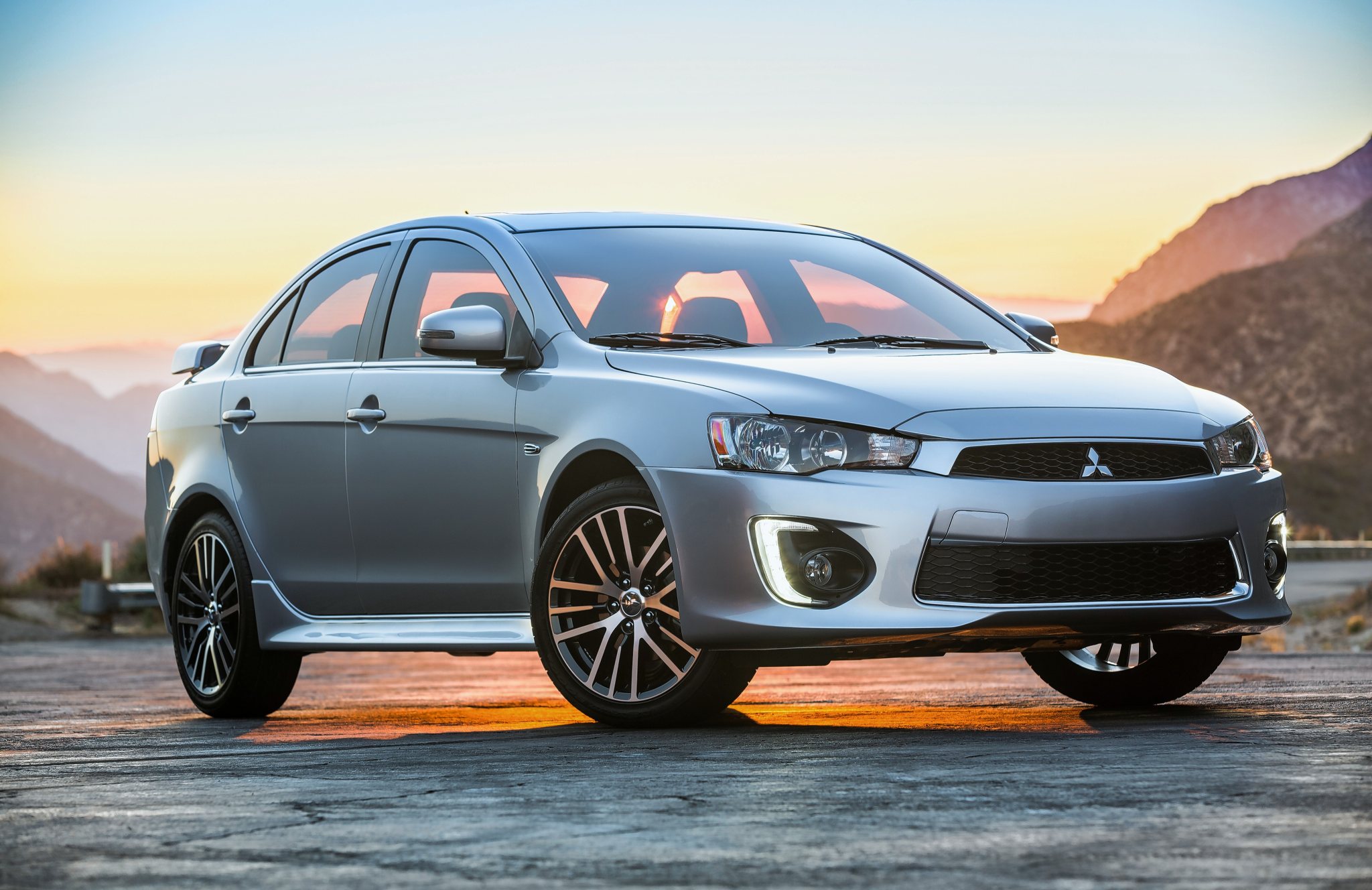


Mitsubishi’s abbreviated 2016 U.S. lineup features smaller-statured, fuel-friendly offerings, minus convertibles, pickup trucks or full-size, heavy-duty SUVs. In fact, its long-running Lancer qualifies as Mitsubishi’s largest (and sole) four-door sedan, despite its compact designate — elevating its profile, by default, to “flagship” sedan status.
However, when measured against rivals, Lancer skews toward the larger end of the compact spectrum, resulting in ample front and rear leg room.
Mitsubishi’s mini menagerie of offerings in 2016 includes the alternative-powered, four-passenger i-MiEV, boasting the lowest price of any all-electric plug-in, starting under $24,000. The subcompact, three-cylinder Mirage rejoins the lineup in 2017 (after a brief 2016 hiatus) with a refresh and a continued promise of 40 miles per gallon.
Mitsubishi loosely translates from Japanese to “three diamonds,” represented visually in the company logo found on the trunk lid’s long, vertical drop, as well as the prominent front grille. Inside, the tri-diamonds visually center the three-spoke steering wheel.
For 2016, Lancer’s exterior facelift includes a revised daytime running light structure featuring LED (light emitting diode) technology, found low along the lower front end and pushed to the corners. Headlight housing flanks a new front fascia with chrome highlights. Side-view mirrors smartly include secondary blinker bands, helping alert those on the road of your next move.
All trims now include aluminum alloy wheels and standard fog lights.
Lancer’s former top-tier Ralliart trim quietly faded away last year. For 2016, the GT trim slots into the top spot to join entry ES and midstream SE and SEL trims.
The turbocharged Mitsubishi Lancer Evolution, a low volume (1,600 units), high wow-factor entry retires upon the close of 2016. It cranks out 303 horses, utilizes high-performance Brembo brakes and sports a can’t-miss rear spoiler. The inspirational “Evo” subcategory could easily return in future products down the road because it’s highly sought after within the “tuner” aftermarket community.
Lancer finds itself in a heated battle with compact-sized rivals that have much heftier marketing budgets and historically strong name recognition, such as Toyota Corolla, Ford Focus and Honda Civic. Compared with its plethora of rivals, Lancer’s platform remains dated, approaching ten years of dedicated service.
Lancer offers two, four-cylinder engines. The value-driven ES is the sole Lancer featuring a 2.0-liter engine (148 horsepower) mated to a five-speed manual transmission. All other trims move up to a 2.4-liter that bumps horsepower to very respectable 168.
A continuously variable transmission (CVT) continues as the high-volume transmission. It’s standard in SE and SEL trims, and available in ES models, all of which come standard with all-wheel control (Mitsubishi-speak for all-wheel drive).
The sport-minted GT comes standard with five-speed manual while offering CVT (with steering wheel paddle shifters) as an option.
A CVT transmission historically delivers improved fuel numbers when compared to a conventional transmission. Expect moderate, but not thrill-seeking acceleration. Our SEL test vehicle’s fuel mileage surpassed 30 miles per gallon highway, impressive for a system incorporating all-wheel drive.
Our well-equipped SEL tester checked in at a tempting $21,995. With no option packages and an $810 factory-to-dealer transportation charge, the bottom line scooted in at $22,805.
Lancer’s base, five-speed manual ES checks in at $17,595, one of the lowest priced four-door compacts with this level of standard equipment. A $1,800 in-dash navigation package with larger 7-inch screen is optional across all trim lines.
Additional value-added cues: Mitsubishi’s ten-year, 100,000-mile powertrain limited warranty (one of the industry’s longest) and fully transferable (to the next owner) five-year or 60,000-mile new vehicle limited warranty.
During spirited turns, expect some body lean. Consistent highway travel brings about a bit of wind noise, but not of an overpowering nature. Audible spinning tire feedback is more noticeable than what’s heard from a variety of competitors, but again not a deal breaker.
While the steering wheel manually tilts up and down, the lack of telescoping capabilities could hamper longer-legged drivers. Cruise-control and secondary audio controls are found on the wheel’s face.
A kite-taillike progression of three buttons extends down from audio functions to monitor hands-free phone commands.
Front bucket seats (with new seat fabrics) manually operate via a pull-bar under seat cushions. Drivers experience good road perception when ensconced in the front bucket thanks to larger-than-average windows.
During Lancer’s next redesign, fuel door and trunk release levers need repositioning to a higher position than on the floor left of the driver’s seat. Also, since both retain black hues, no contrast exists between levers and black floor mats and carpeting.
To the instrument panels left, a push button will toggle through a half-dozen digital window tutorials (trip mileage, digital speedometer) between two circular, deep-set analog gauges. A more user-friendly local for the button would be the steering wheel, eliminating the left-arm stretch.
Kudos for Lancer retaining three large, easy-to-grab dials for manually adjusting fan speed, direction and temperature. Some may consider this old school, but the simplicity of operation keeps driver’s better focused on the task at hand — eyes focused on traffic ahead.
Beneath is a cove with 12-volt outlet and a USB port for connectivity of portable electronics.
The tidy trunk region (12.3 cubic feet) benefits from strut-tower like hinges outside the cargo hold, reducing the chances of unintended box squash from interior-mounted gooseneck designs.
Mitsubishi mothballed its sole U.S. production facility in downstate Normal near Bloomington last year. At peak performance, in the early 2000s, the facility churned out six models, building more than 220,000 vehicles annually. In 2014, the plant built 69,178 Outlander crossovers, the sole model built in Illinois during its final year, with about half exported overseas.
The Prairie State facility opened in 1988 as a joint venture between Chrysler Corp. (now an intricate part of Fiat Chrysler Automobiles) and Mitsubishi. A few years later in 1991, Mitsubishi bought out Chrysler’s stake. This spring, the plant was purchased by a liquidation firm with a substantial track record of automotive assembly plant repurposing.
Two Illinois assembly plants remain operational: Fiat Chrysler Automobile’s Belvidere plant adjacent to the Northwest tollway in Boone County and Ford Motor Co.’s Torrance Avenue complex dotting Chicago’s far south side.

