


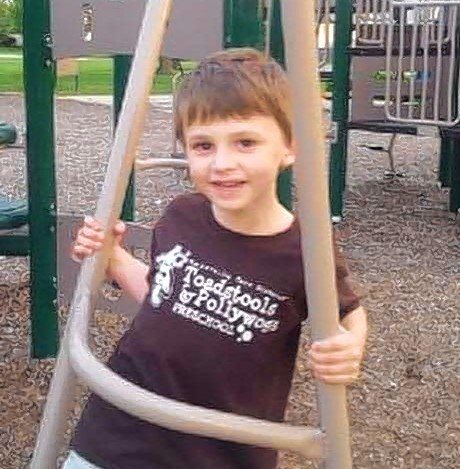


Five-year-old Brendan Schwalm is heading to kindergarten this fall. Brendan has loads of energy, is extremely social and very excited to make new friends. Mom, Eileen, is also looking forward to the start of kindergarten. Her excitement comes from seeing how far Brendan has come the last few years and is confident he is now ready for all that kindergarten has to offer.
As little as two years ago, when Brendan was in preschool, he struggled. He loved going to school, but his enthusiasm often got the best of him. Brendan was an only child who spent most of his time with adults so he didn’t quite understand how to play with peers.
The teacher approached Eileen about Brendan’s behavior at school. He was hitting classmates and running around the room. He was having difficulty focusing on tasks, transitioning and ultimately not making the friends that he was so excited to make.
“At first I was taken back,” recalls Eileen. “I remember thinking he was just active. He was just 3 years old and a little boy. Weren’t most 3-year-old boys like that?” Eileen admits it took a bit of time to digest all the teacher was telling her.
She says she didn’t take it personally though and eventually welcomed any additional help she could get. “Why wouldn’t I want him to be the best Brendan he can be,” continues Eileen. Because the preschool was a Naperville Park District program, the teacher suggested looking into inclusion services with their local Special Recreation Association which happened to be the Western DuPage Special Recreation Association (WDSRA).
With inclusion services, accommodations are made within the program based on your child’s specific abilities, level of function, age and interest. They are customized to meet your child’s needs with the goal of helping your child be successful in participating at their highest level of ability.
Inclusion recommendations often include an extra set of hands to accompany your child … a “buddy” who is well trained and well versed in your child’s needs. They are chosen specifically with your child’s personality in mind and have the tools, sensory materials and/or program modifications designed specifically for your child.
Danny McFadden, age 2½ and nonverbal, screamed anytime he was separated from mom, Rebecca. His attachment disorder got worse with the arrival of a new baby in the family. Rebecca knew she had to help Danny overcome his anxiety. He would have to be able to tolerate short separations whether it was for therapies, preschool or just everyday life. Rebecca also knew exposure to children his own age was important and that preschool was a great way to accomplish that. But being able to separate from mom was the hurdle in front of them.
Rebecca was introduced to inclusion services through a resource fair. Because Danny had a formal diagnosis of a rare genetic disorder, he qualified for the services. Rebecca signed Danny up for a park district program that would help with the gradual separation of mom and child. The first class included both mom and child together.
“I knew it would take baby steps,” explains Rebecca. “So I asked the teacher if she would allow me to leave the room for five minutes at a time.” Through inclusion services, a buddy was paired with Danny to help him transition from screaming when mom left to hugging a new special friend, a plush Elmo.
“I started to feel like he was getting more comfortable and was ready for the next step,” says Rebecca. “So I signed him up to do the second class on his own.” The second class was without mom. The first few days Danny was sullen and not very playful. But when he finished that first class with the help of his buddy, it was a significant moment for both Danny and mom. “Afterward he gave me the biggest, tightest hug I had ever gotten from him,” remembers Rebecca. “I knew then that he understood I could leave but would always come back. It was a huge step.” Danny did gradually became more interactive with his peers, and after six weeks his separation anxiety level was dramatically lower and so was mom’s.
Though Brendan does not have a formal diagnosis, WDSRA was able to help him, too. The goals established for Brendan included improving social skills and helping him gain an age appropriate level of self-control. Brendan would be most successful with a one-on-one buddy to help him understand and navigate the expectations of preschool. A behavior plan was put in place to reinforce his positive choices. He earned ninja stickers and was even able to work toward a prize. The positive reinforcement helped him learn and practice the skills he would need before entering kindergarten.
“I was surprised at just how quickly his behavior improved with the guidance and positive reinforcement he got,” recalls Eileen. Brendan really liked and respected his inclusion buddy. She worked side-by-side with him at every class helping him develop both social and listening skills.
Eileen liked the fact that his buddy could help her not only understand what Brendan was doing in school, but also help her understand how to carry on that learning at home. “I learned a whole lot about how Brendan acts in school; how he behaves and treats others,” says Eileen. “I would get reports on how he did that day, what he worked on and exactly what we needed to work on at home.”
Getting good reports from school was a tremendous boost to Brendan’s confidence too. He would even go into class telling mom he was going to come home with a good report that day. She knew he could do it but now he knew it too.
Though preschool is behind them, Eileen continues to see examples of Brendan’s growth in other areas. He recently attended a birthday party where she saw a marked improvement in his ability to play and communicate with other children. Eileen is grateful for the help she received through inclusion services. More importantly, she is “thrilled with seeing Brendan be the best Brendan he can be.”
As for Danny, who just turned 3, he and mom continue to work on short separations. Rebecca has seen tremendous improvement. She can now leave the room and even take short breaks away from Danny because he understands she will be back. Rebecca knows she has to be patient but is hopeful that Danny will be ready for preschool this fall.
Could your child benefit from inclusion services? Inclusion services are offered through your local Special Recreation Association (SRA). Services are free for residents registered in any participating park district program including park district run preschools. Some SRAs require a formal diagnosis. Contact your SRA for a consultation. To find your SRA visit www.specialrecreation.org.
• Sherry Manschot is the marketing/public relations manager at Western DuPage Special Recreation Association. She leads a parent network of special needs families at WDSRA. Manschot can be contacted at sherrym@wdsra.com. More information about WDSRA can be found at wdsra.com.

